“¡Lo mejor del mundo!”: Creating Community in the Kids Section of the International Institute’s Library
“Here, there are parents of all cultures,” says one amigo de la biblioteca, describing the community of the kids’ section of the International Institute of Madrid ‘s library. “But between one another, we usually communicate in English.”
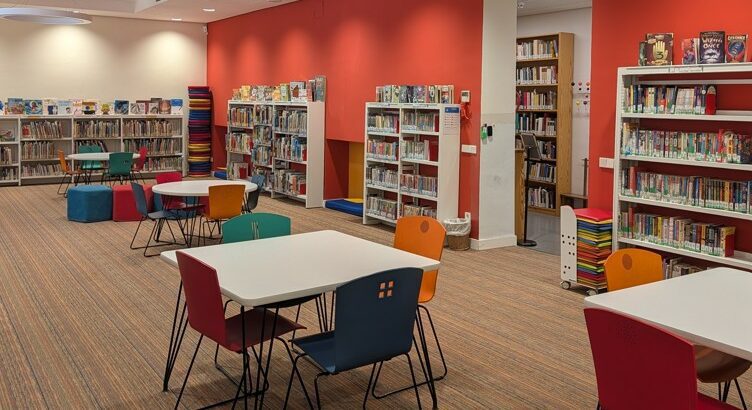
On a typical afternoon in the library, it’s not unusual to spot kids drawing on the whiteboard-walls, parents reading to their kids, and toys rolling aimlessly across the floor. Despite its technical location as a basement, the kids’ section of the library is always full of light and chatter—a space for learning, literature, community, and, above all, a mixture of languages and constant communication. Snippets of Spanish and English frequently fill the walls of the library.
However, the International Institute of Madrid retains a much vaster, richer history than one could ever imagine at first glance—a history inextricably interwoven with the grand access to English literature that the Institute now boasts today. Similarly, the community that the library possesses is the result of more than a century’s worth of perseverance, change, and adaptation. With the mission of intercultural dialogue front and center, the International Institute of Madrid is a uniquely situated organization in the epicenter of the bustling Spanish capital—there is not another establishment like it in the city.
The International Institute of Madrid began as a small boarding school operated out of the home of Alice Gordon Gulick, an American woman intent on dedicating herself to eliminating educational barriers for Spanish women. Though the building on Miguel Ángel 8 would not be established for more than a decade, the Institute’s mission remained ever clear: improve access to education for Spanish women, and adopt a learning module similar to those of North American colleges to help improve cross-cultural dialogue. Over the course of the next century, the Institute would encounter a variety of rampant changes: a gradual decrease in philanthropic funds from the US due to the onset of the first World War, the start of the Spanish Civil War—in which the US embassy rented out to building to shelter its interests from political intervention—and a slight shift in public-projecting tone in order to comply with the following dictatorship. Even still, despite political unrest, the Institute set out to remain true to its mission of supporting education and opened its doors to American universities once again in the 1950s, supporting many study abroad programs just as it does today.
On a typical walk through the Institute, it is not uncommon to see a variety of canvased images plastered to the walls: pictures of the Institute’s first cohorts, of chemistry labs, and of traditional classrooms from Miguel Ángel 8. Above all, the Institute is a striking mix of past and present—of history and modernity. After a century’s worth of change—and especially now, in a time of heightened political polarization—the Institute provides a unique sense of intercultural community. “For me, it is a way of connecting with Madrid,” says the same amigo de la biblioteca when describing the opportunities that the library provides, both in its vast section of classic American children’s literature and its diverse community.
As a study abroad student at Stanford in Madrid, the library also offered me a unique opportunity to connect with the city. Though I arrived in Madrid with just enough of a baseline in the language to commit to my program’s immersion requirement—I could take classes, interact with my homestay, and participate in daily conversation without much pain—I was at first completely unaccustomed to the nuances of Spanish culture, and felt far from home. I grew up in a town just forty miles north of Milwaukee, Wisconsin, surrounded by endless cornfields and cow pastures, and though my university journey started with a sudden rupture—two years ago, I left the cornfields of my youth for Stanford and the ever-moving Bay Area—my arrival in Madrid seemed sudden, and almost frightening at first. However, as I began to work my internship at the International Institute’s library, I was thrust into the world of intercultural Madrid—a world of literature, bilingualism, and community.
After interviewing various amigos de la biblioteca, or friends of the library (parents, guardians, nannies, and kids who frequent the library’s kids’ section), one common thread made itself clear throughout every conversation I had: it is the cross-cultural environment (the availability of literature, the variety of families and kids who enjoy it) that the library provides that makes it so appealing. It is its situation as a bridge between North America and Spain, between families of various backgrounds and nationalities, that creates such a warm, welcoming atmosphere in the basement of the International Institute.
Of course, there are also a variety of “classics” that make the library a place to constantly return to—books that families and kids just can’t quite put down, and some with notoriously long waiting lists. These include the Geronimo Stilton and Thea Stilton series, books by Jude Blume (the famous Ramona series) and Mo Willems (the Pigeon series), as well as the I Survived, Magic Treehouse, and Rainbow Fairy books. Other than the wide availability of English-language children’s books, the library is also a frequent place for playdates, board games, various events and workshops (everything from music to crafts!) for young children, and a book club between parents referred to as “Bring your own baby.” This summer, “Camp Boston,” a summer camp focused on creativity, innovation, and American culture, is also making its way to the International Institute, with book themes ranging from “Travel Around the U.S.” to STEM to music.
As its founders intended, the library extends a unique position as a tipping point between North American and Spanish culture—a sort of intercultural, literary oasis in the heart of Madrid. The Institute also offers English courses for members of the community, yet the courses feature a North American emphasis as opposed to the typical Anglophobic English taught in Spain. Even such an act—featuring North-American culture as opposed to British culture in its English courses—is deeply rooted in the Institute’s history. For years, the British Council sat just around the corner from Miguel Ángel 8, and when the Institute began its English courses, choosing to emphasize North American English instead of British English, it was atypical and challenged the status quo. Simultaneously, as the library developed and began to collect a wide variety of English—specifically American literature—the Institute has remained a pillar of the U.S.-Spain relations.
In other words, the library has remained a stronghold of the International Institute’s emphasis on intercultural understanding for years. Both English and Spanish function as bridging languages between families of different cultural backgrounds, as they enjoy the wide variety of books and games available in the kids’ section. In order to feel part of such a strong community, various other amigos de la biblioteca say that they enjoy conversing with the library and Institute staff just as much as chatting between families and participating in events. Not only does the availability of literature help many kids and families practice and keep up English—as well as provide a sense of nostalgia and “home” for those who come from the United States—but it also allows for the creation of a community inherently based in intercultural empathy.
Overall, the International Institute of Madrid, specifically its library with a unique, wide range of American kids’ literature, hosts a community unlike any other. Moreso, as a current international student in Madrid, thousands of kilometers from home, I too immediately felt welcomed and at home in the library’s doors, as do many families who visit weekly with their children. All of this is to say that institutions such as the International Institute such as the library, are absolutely critical in fostering understanding and connection in times of increasing polarization. Just as the founders intended to bring a snippet of North America to Spain and to support education amidst a world of uncertainty, the Institute and library today act as a place of learning and compassion between individuals of all backgrounds. As one young amigo de la biblioteca stated while collecting a new stack of books to take home for the week, “That’s why it’s the best in the world!”
Addie Rahmlow is a study abroad student with Stanford in Madrid completing an internship with the library of the International Institute. She studies International Relations and Creative Writing.


